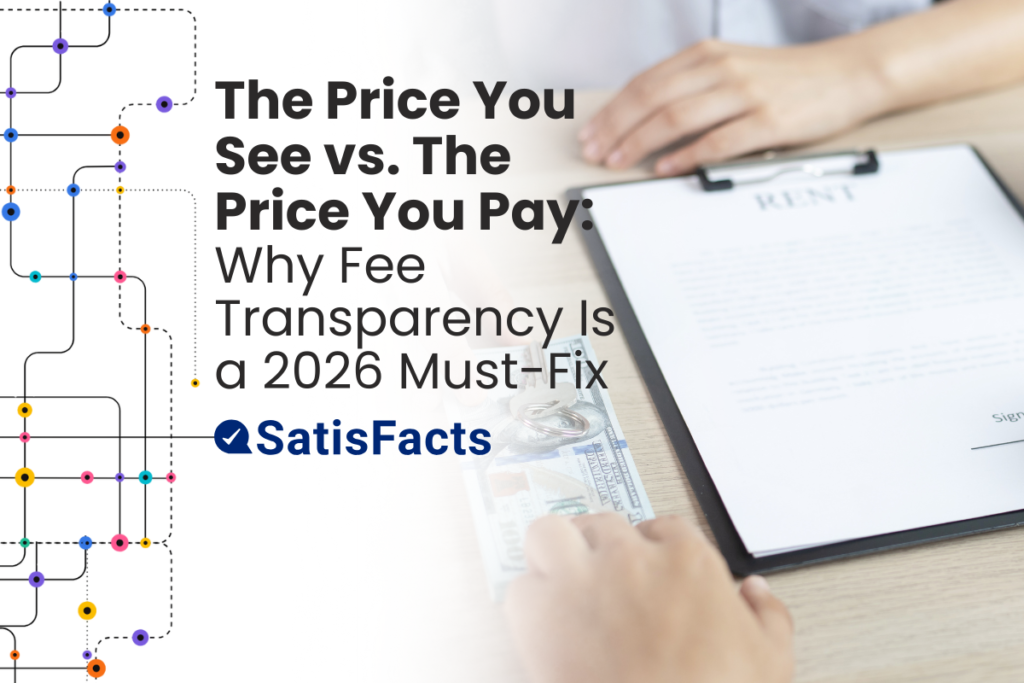
There’s the rent on the listing, and there’s the rent on the ledger. The space between the two is where trust gets lost—and reputations take the hit.
The SatisFacts 2025 Biennial Online Renter Study goes beyond search and reviews, asking renters across the country about mandatory fees, utility billing, internet agreements, credit reporting, and the tech that actually helps residents manage costs. The story is consistent: renters want the whole number up front, and they’re quick to penalize surprises. Learn more about why fee transparency Is a 2026 must-fix.
What The Data Says About Fee Transparency (And Why It Matters)
- Fee transparency is the top information need. “Information on mandatory fees beyond the advertised rent” ranked #1 again, scoring 4.64/5 in 2025 (vs. 4.74/5 in 2023). Importance dipped slightly—but it still leads every other information item.
- Hidden fees are the leading trigger for negative reviews. In 2025, 56.4% of renters say unclear or unexpected fees would prompt a negative review—the highest of any reason we tested in 2025.
- What renters want companies to be transparent about:
- #1 Mandatory fees in addition to rent — 83.3% (2025) vs. 81.2% (2023)
- #2 How rent prices are determined — 70.7% (vs. 71.3%)
- #3 Utility billing practices and usage charges — 64.8% (newly measured)
- #1 Mandatory fees in addition to rent — 83.3% (2025) vs. 81.2% (2023)
- Disclosure is improving—but not solved. 84.9% reported they were informed of all charges and fees before signing (up from 77.1% in 2023). That still leaves 15.1% who were not informed—exactly the group most likely to feel blindsided and post negative reviews.
- Invest where residents actually feel value. The most useful tech is practical and cost-reducing:
- Online rent payments: 85.2%
- Online lease renewal: 78.3%
- E-signing: 77.5%
- Package lockers/notifications: 70.3%
- Online service requests: 68.9%
- Online applications/reservations: 67.2%
- Keyless/smart access: 60.1%
- Flexible rent payment options & rewards: 57.5% (ranked #8) — notably above smart-home controls at 51.8%, and far above virtual concierge at 24.3% and 24/7 AI chat at 15.9%.
- Online rent payments: 85.2%
Translation: residents favor tools that make paying, planning, and avoiding additional fees easier over shiny add-ons.
Operator Takeaway: Brand Risk is Operational
When fee clarity slips, the impact isn’t theoretical—it’s operational. When residents are surprised, escalations increase, CSAT and renewal intent decline, and negative reviews accumulate. Your “brand” isn’t what you post online; it’s whether you consistently meet the expectations the data makes plain—total monthly cost up front, plain-language fees and utilities, and a clear explanation of how rent is set.
“Renters’ expectations are your brand promises. Meet them consistently or pay for it in trust and reviews.”
Does “being informed before signing” change how important fee information is?

Disclosure doesn’t reduce demand for fee details—it coexists with it. Even when informed, renters still want fees spelled out up front. (informed M=4.65, SD=0.87; vs. not informed M=4.58, SD=0.97; p<.001).
A Simple Transparency Playbook
- Publish the total
Show advertised rent + recurring fees + typical utilities as an estimated monthly total. Keep it current and easy to print. - Name every fee, once
If it appears on a ledger, it appears on your website, tour sheets, and emails—same name, same definition, same amount or range. - Preview the ledger
Provide a mock Month 1 statement and a “normal month” example before they sign. Eliminate eleventh-hour surprises. - Explain the “why”
Train teams to articulate what the fee covers and how it benefits the resident. If the explanation is messy, reconsider the fee. - Check the stack
One fee may be defensible; the pile often isn’t. Audit admin, portal “convenience,” bulk internet, pet, and utility passthroughs for cumulative impact. - Measure what matters
Track “fee” and “charge” mentions in lead notes, survey open-ends, and reviews. Watch perceived value and trust after move-in. Aim to shrink the 15% who say they weren’t informed.
Why SatisFacts Data Is Different
Surface-level metrics miss this. Our study doesn’t just ask if renters use a channel—it captures what details they need, where trust breaks, and which operational choices reduce friction. The longitudinal view (2011–2025) makes the signal clear: fees and transparency aren’t side notes; they’re decision drivers.
If you’re setting 2026 priorities, start with fee clarity. It lowers conflict costs, protects reputation, and improves conversion—because people sign faster when the math makes sense.